
A founder in Jos once told me she had never seen a grant open to organisations like hers. Not one. In the same month, I counted at least four calls she qualified for. She was not unlucky. She simply did not know where to look.
That is the real problem for most small organisations. Funding opportunities for NGOs in Africa exist every week. They are scattered across portals, embassy pages, newsletters and foundation websites. If nobody on your team checks them on a schedule, the deadlines pass quietly.
This post gives you nine places to look and a simple routine to check them. It is the habit behind every list of opportunities I publish, including my roundup of development funding opportunities in Africa for 2026.
Why Most NGOs Miss Funding Opportunities
Three things usually go wrong.
First, nobody owns the search. The executive director assumes the programme officer is looking. The programme officer assumes the director has contacts.
Second, the search is random. Someone scrolls social media, sees a call two days before the deadline, and the team rushes a weak application.
Third, the organisation applies to everything. A youth group applies for a health systems grant because the amount is large. It loses, and the team gets discouraged.
The fix is a short list of reliable sources, checked on a fixed day, filtered by clear criteria.
9 Places to Find Funding Opportunities for NGOs in Africa
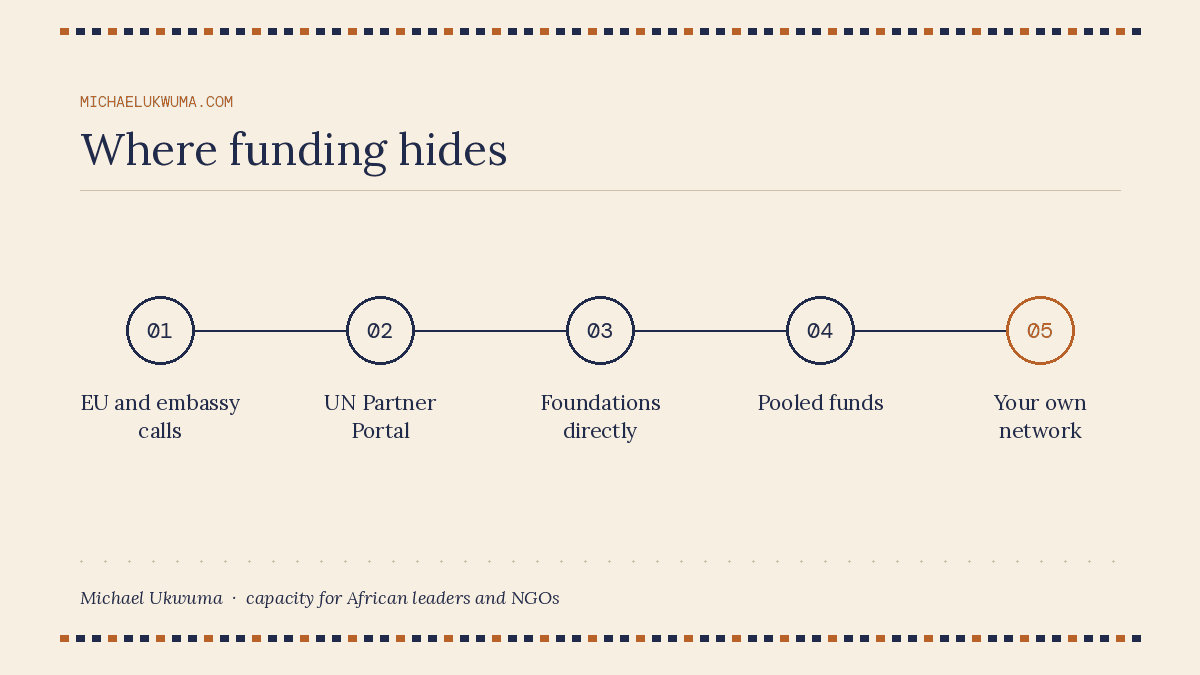
1. The EU Funding and Tenders Portal
The European Union publishes its calls here, including many open to African civil society organisations, often through partnerships with European groups. Calls are detailed and competitive, so you need strong systems. I explained the main programmes in my posts on Horizon Europe for African nonprofits and Erasmus and ESF funding.
Also check the EU delegation page for your own country. Delegations run local calls for civil society that never trend on social media.
2. The UN Partner Portal
Several UN agencies use the UN Partner Portal to find civil society partners. Registering your organisation and keeping the profile complete lets you see calls for expression of interest from participating agencies. It costs nothing. Many small NGOs have never heard of it.
3. Embassy small grants schemes
Many embassies run small grants for local organisations. The Canada Fund for Local Initiatives is one well known example, and several other governments run similar schemes through their embassies. Amounts are modest, but competition is local and the application is short. For a young NGO, an embassy grant is often the first institutional money it receives.
Visit the websites of the embassies in your capital and look for sections on small grants or local initiatives.
4. Foundation websites directly
Large foundations rarely advertise on aggregator sites. Make a list of ten foundations that fund your issue in your region. Read their strategy pages. Note whether they accept unsolicited proposals or work by invitation only. Check those pages once a month.
If a foundation accepts letters of inquiry, read my guide on how to write a letter of inquiry for a foundation grant. For a wider list of funders, see my roundup of top donor and grant making organisations in Africa.
5. Funding newsletters and aggregators
Sites such as fundsforNGOs and DevelopmentAid collect calls from many donors in one place. Some content is free and some needs a paid membership. Pick one or two and subscribe to their Africa or sector specific alerts. Always click through to the original donor page before you apply, because aggregators sometimes carry outdated details.
6. Pooled and intermediary funds
Some donors give money to intermediary funds that then make smaller grants to grassroots groups. Women’s funds, human rights funds and climate funds often work this way. These are excellent for small NGOs because they understand local realities and often accept simpler applications.
7. Corporate and foundation programmes in your country
Banks, telecom companies and oil and gas firms often run foundations or social investment programmes. Their calls are announced locally, in newspapers and on their own websites. Build a relationship with the corporate social responsibility team before a call opens.
8. Government and multilateral programmes
Development banks and government agencies sometimes fund civil society directly, or through implementing partners. Your state or national ministry may also have grants linked to youth, agriculture or women’s empowerment. These are slower but worth tracking.
9. Your own network
The most valuable source is still people. Partner organisations, former colleagues, consortium leads and programme officers you met at events. Tell them clearly what you do and what you are looking for. Many of the best opportunities I have seen came through a forwarded email.
A Weekly Routine That Takes One Hour
Here is the routine I recommend.
Pick a day. Monday morning works for most teams.
Assign one owner. One person checks every source on the list.
Use a simple tracker. A spreadsheet with columns for donor, programme, deadline, amount, eligibility, fit score and next step.
Score the fit. Rate each opportunity from one to five on mission fit, eligibility and capacity to deliver. Only pursue fours and fives.
Share once a week. Send the shortlist to leadership with a recommendation. Decide quickly. Deadlines do not wait for management meetings.
Check Eligibility Before You Fall in Love
Every call has rules. Registration status. Years of operation. Minimum turnover. Audited accounts. Geographic focus. Read these first, before the exciting parts. If you do not qualify, move on or look for a partner who does.
If you qualify but lack a track record, my post on how to write a funding proposal when you have no track record will help. And for community projects, see my list of grants for community development in Africa and my guide to funding platforms for African nonprofit founders.
Turn Searching Into Winning
Finding opportunities is step one. Winning them takes a strong proposal, a believable budget and an organisation that looks ready to manage money.
If your team spends hours searching but rarely wins, I can help. I work with African NGOs on funding strategy, proposal writing and the systems funders look for. See my grant writing and consulting services or get in touch to talk about your next application.