
Every week someone sends me the same message. “Sir, I want to grow in the NGO sector. Which certificate should I get?” They have seen job adverts asking for project management skills. They have heard of PMP. They are not sure it fits the work they do.
If you work in development, humanitarian response or community programmes, the nonprofit project management certification most built for your world is Project DPro. It was developed by PM4NGOs, a group of practitioners from the development sector, and it speaks the language of logframes, beneficiaries and donor compliance rather than corporate product launches.
I compared the main options in my post on Project DPro vs PMP vs PRINCE2 for NGO professionals. This post is the next step. You have chosen Project DPro. Now how do you actually prepare?
Why Project DPro Is Worth Your Time
Let me be direct. A certificate alone will not get you a job. But the right certificate does three things for an NGO professional.
First, it gives you a shared vocabulary with international colleagues and funders. When a donor asks about your risk register or your project charter, you know exactly what they mean.
Second, it signals to recruiters that you understand the full project cycle, not just the activities you personally ran.
Third, the study itself makes you better at your job. Many people tell me they finally understood why their projects kept running late only after studying the planning phase properly.
What Project DPro Covers
The guide is organised around the project lifecycle as it plays out in development work. You will study:
- Identification and design. Needs analysis, problem trees, stakeholder analysis and the logical framework.
- Project set up. The project charter, governance and roles.
- Planning. Work breakdown, scheduling, budgeting and risk.
- Implementation. Managing teams, partners, procurement and change.
- Monitoring, evaluation and control. Tracking performance and making decisions with data.
- End transition. Closing well, handing over, and capturing lessons.
It also covers the principles behind good project management in development settings: accountability to communities, participation, and adapting to complex environments.
The official guide is available from PM4NGOs, and the exams are delivered through their accredited partner. Exam formats, fees and pass marks can change, so check the current details on the official PM4NGOs and examiner websites before you register.
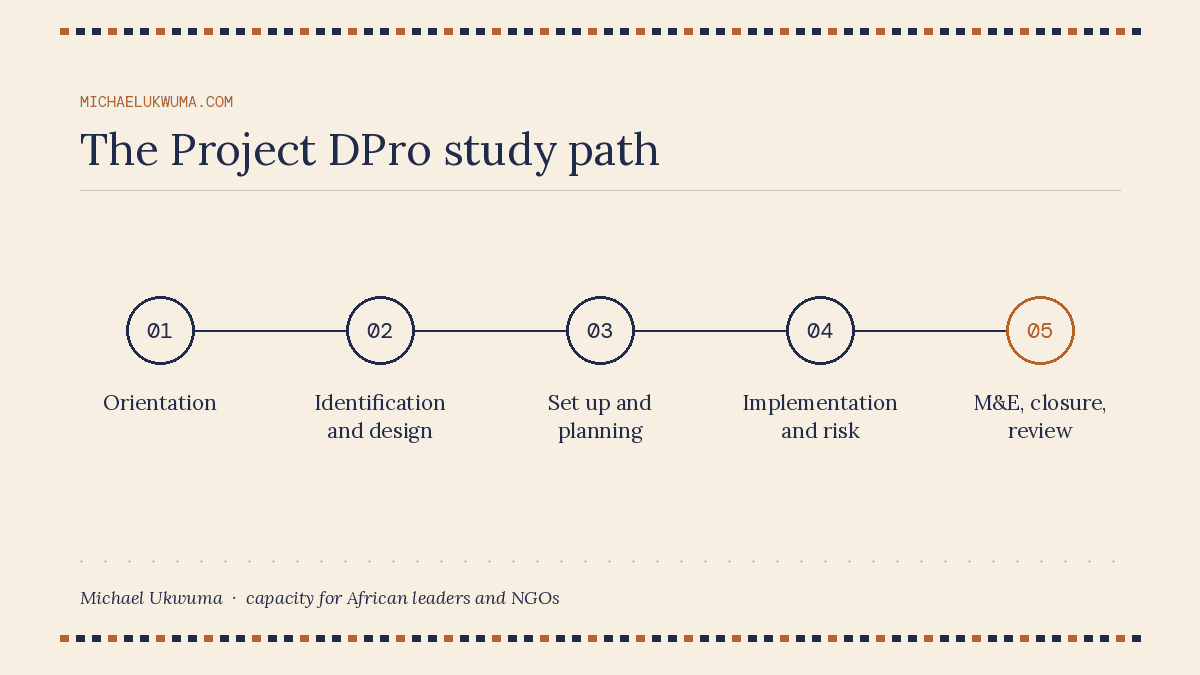
The 6 Week Nonprofit Project Management Certification Study Plan
This plan assumes about five to six hours a week. That is one hour on four weekday evenings and a longer session at the weekend. It is built for people with full time jobs and family responsibilities.
Week 1: Orientation and the big picture
Download the official guide. Read the introduction and the overview of phases. Do not take detailed notes yet. Just understand how the pieces fit. At the weekend, draw the project lifecycle from memory on one sheet of paper.
Week 2: Identification and design
This is the heart of development work. Study needs assessment, problem trees and the logframe in depth. Then do something practical. Take a project you worked on and rebuild its logframe. Where were the assumptions weak? This exercise teaches more than rereading. My guide on how to write a logframe walks through the format step by step.
Week 3: Set up and planning
Work through the charter, work breakdown structure, scheduling and budgeting chapters. Build a simple schedule for an imaginary project in a spreadsheet. If you already use a tool at work, try it there. My post on project management tools for NGOs lists options that work on a small budget.
Week 4: Implementation and risk
Study risk management, procurement, partner management and change control. Write a risk register for your current project at work. Share it with your manager. You will be surprised how quickly people start treating you as the project lead.
Week 5: Monitoring, evaluation and closure
Read the chapters on monitoring, control and end transition. Pay attention to the difference between monitoring and evaluation, and to how closing a project responsibly protects the community after funding ends.
Week 6: Practice and review
Take every practice question you can find from official sources. For each wrong answer, go back to the guide and read the section again. Spend the last two days reviewing your one page lifecycle drawing and your notes on key terms. Rest the night before the exam.
Study Tips From People Who Passed
- Study in a group. Two or three colleagues meeting weekly on a call keeps everyone accountable.
- Connect theory to your own projects. Every concept should remind you of something real.
- Learn the definitions exactly. The exam rewards precise understanding of terms.
- Do not cram. Spaced study over six weeks beats three sleepless nights.
What If You Cannot Afford It Right Now?
Money is real. If the exam fee is out of reach this month, start with the free learning first. Download the guide and work through the plan anyway. You will gain the knowledge even before you have the certificate. My list of free project management courses for NGO professionals can fill the gap while you save. Some employers will also fund the exam if you show them a clear study plan like this one.
After the Certificate
Passing is the beginning. Update your CV with the certification and, more importantly, with a project where you applied what you learned. Talk about the risk register you built. Talk about the logframe you fixed. Recruiters hire evidence, not paper.
If you want to know where this certification fits in your wider career path, read my guide on the best project management certifications for NGO professionals.
Ready to Build Your Career Plan?
Certification is one piece of a bigger plan. If you are trying to move into programme management, step up to a senior role, or switch into the NGO sector entirely, I offer career coaching built for African development professionals. Explore my coaching and training services and let’s map your next move together.