
The job advert said it plainly. “Programme Officer, MEAL. Minimum three years experience. Certification in monitoring and evaluation is an added advantage.” Adaeze read it twice. She had been collecting data for two years. She had built dashboards. She had no certificate.
She sent me one question. “Which monitoring and evaluation certification should I get?”
It is a fair question, and the answer is not obvious. Unlike project management, where a few big names dominate, M&E has no single global certificate that every employer recognises. That is both the problem and the opportunity. In this post I will walk you through the main options, what each one signals, and how to choose.
If you are still deciding between M&E and project management as your main track, start with my comparison of Project DPro, PMP and PRINCE2 and my list of the best project management certifications for NGO professionals. Many people end up with one of each.
Why a Monitoring and Evaluation Certification Helps
Let me be honest first. Employers hire M&E people for what they can do. Can you design a results framework? Can you build a data collection tool? Can you clean data, analyse it and tell a story that changes decisions? A certificate does not replace that.
But a good certification helps in three ways. It fills gaps in your knowledge, especially if you learned on the job. It gives you the standard vocabulary donors use. And it gives a recruiter a quick signal when they are reading two hundred CVs.
The Main Options
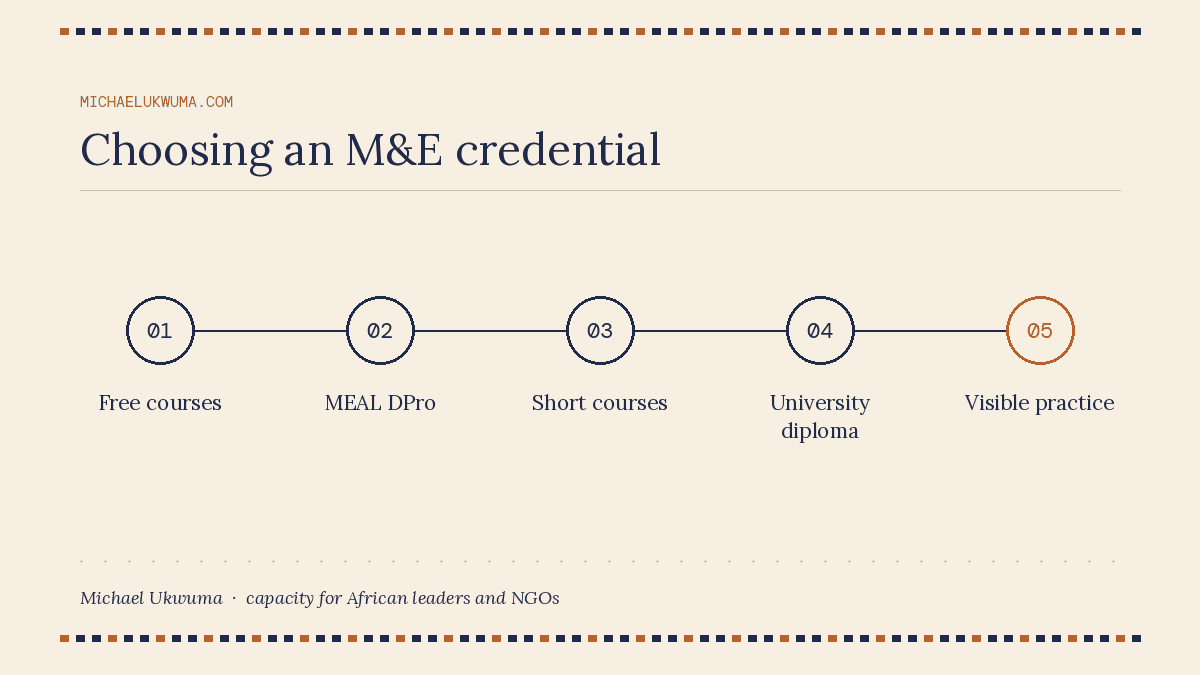
1. MEAL DPro from PM4NGOs
PM4NGOs, the same group behind Project DPro, publishes a guide called MEAL DPro. MEAL stands for monitoring, evaluation, accountability and learning. It is written for development and humanitarian staff, so the examples feel familiar. The guide covers designing a MEAL system, planning data collection, analysis, using information for decisions, and accountability to communities.
There is a certification linked to it. Check the PM4NGOs website for the current exam format and cost before you plan, since these details change.
Best for: officers and assistants who want a recognised, sector specific credential.
2. Free online courses from sector platforms
Platforms such as Kaya, from the Humanitarian Leadership Academy, offer free courses on MEAL and related topics with completion certificates. Other NGO learning platforms offer similar modules.
These certificates carry less weight on their own. But they are free, practical and a good way to build foundations before a paid exam.
Best for: beginners and career switchers testing whether M&E suits them.
3. Paid professional short courses
Training organisations that serve the NGO sector, such as Humentum, run paid courses on M&E, often with live sessions. Several regional training institutes in East and West Africa do the same. Quality varies, so look at the trainers, the syllabus and past participants before paying.
Best for: mid level staff whose employer will sponsor training.
4. University certificates and diplomas
Many universities in Africa and abroad offer postgraduate certificates or diplomas in monitoring and evaluation, some online. These are longer and more expensive, but they carry academic weight and go deeper into research methods and evaluation theory.
Best for: people aiming for senior M&E or evaluation specialist roles.
5. Professional associations
National evaluation associations and the African Evaluation Association run conferences, webinars and training. Membership is not a certification, but it builds your network and keeps you current. Listing active membership on your CV shows commitment.
How to Choose the Right Monitoring and Evaluation Certification
Ask yourself four questions.
Where am I now? If you are new, start free. If you have experience but no paper, a recognised sector credential like MEAL DPro gives the most value for the money.
What does my target employer ask for? Read ten job adverts for the role you want. Note which certificates and skills appear. Let the market guide you.
What can I afford in time and money? A university diploma is a big commitment. A short course or self study exam is not.
What skill gap is most urgent? If you struggle with data analysis, a course with practical work in Excel, Power BI or a statistics package may help more than a theory heavy certificate.
Build Skills Alongside the Certificate
Whatever you choose, pair it with visible practice. Volunteer to redesign your organisation’s indicator tracker. Write a short learning brief from your monitoring data. Help build the logframe for a new proposal. These are the stories you will tell in interviews.
If you want to see how M&E fits into the wider project cycle, read my guide on organisational capacity assessment for NGOs, where M&E is often one of the weakest areas organisations score themselves on.
What Happened to Adaeze
Adaeze started with free courses for a month, then took a sector specific certification. She rebuilt her CV around two projects where her data changed a programme decision. Four months later she got the MEAL officer role.
The certificate opened the door. Her evidence walked her through it.
Plan Your Next Career Step
If you are trying to grow into an M&E role, or move from officer to specialist, I offer career coaching built for African development professionals. We map your gaps, choose the right certification and plan the experience that makes recruiters call. Explore my coaching and training services or send me a message.