
I once sat on a hiring panel for a programme officer role in Lagos. We received more than three hundred applications. The HR officer printed the shortlist candidates’ files and placed them on the table. One by one, we read the cover letters.
Most of them began the same way. “I am writing to apply for the above position as advertised on your website.” Some of them were addressed to the wrong organisation. One mentioned a different job title entirely.
Then we read a letter that started with a story about a youth group in Kaduna. Within four lines, we knew who this person was and why they cared. We invited her for an interview that afternoon.
That is the power of a good NGO cover letter. It is your one chance to sound like a human being before anyone meets you.
Why the NGO Cover Letter Still Matters
Some people say cover letters are dead. In the NGO sector, they are not. Development organisations care about motivation and values. They want to know why you want to work on this issue, with these communities, in this organisation. Your CV cannot tell them that. Your cover letter can.
A strong letter also shows writing ability. Almost every NGO role involves writing: reports, proposals, emails to donors. If your letter is clear and specific, the panel assumes your reports will be too.
The Simple Structure That Works
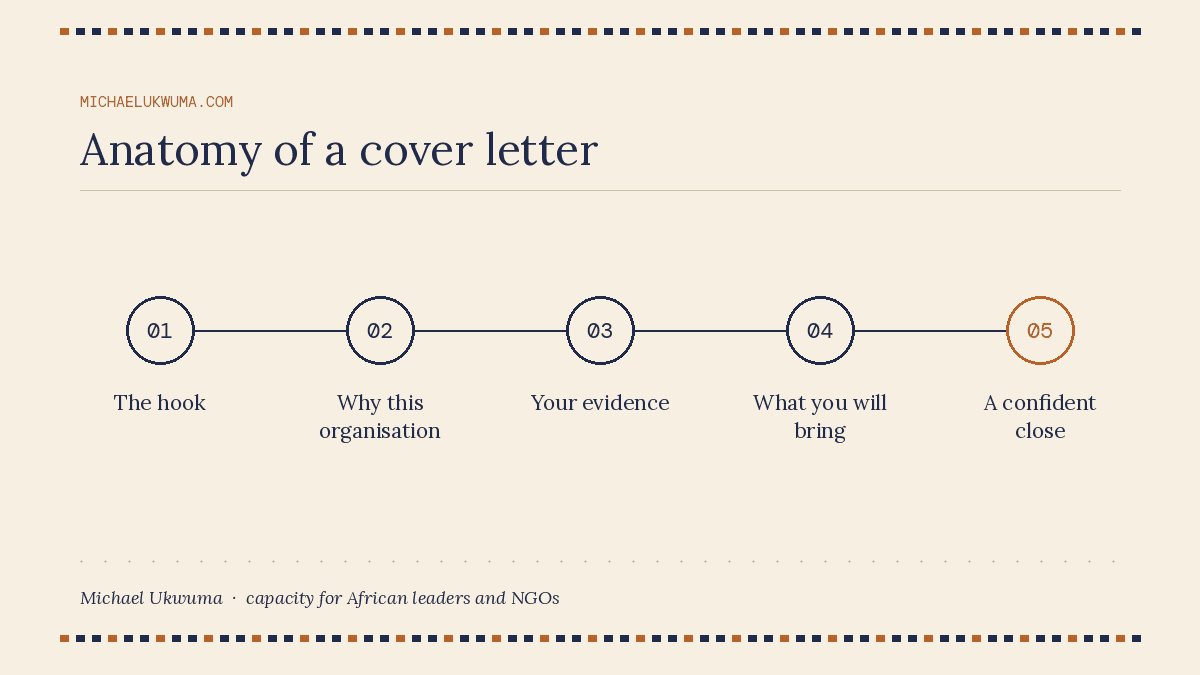
Keep it to one page. Four or five short paragraphs. Here is the structure I recommend to everyone I coach.
Paragraph 1: The hook
Open with something specific that connects you to the mission. A moment from your work. A result you achieved. A reason the issue matters to you. Then name the role in the same paragraph.
Example: “Last year, I helped 40 women in Nasarawa set up savings groups that now hold more than two million naira in shared funds. I want to bring that experience to the Livelihoods Officer role at your organisation.”
Notice that there is no “I am writing to apply”. The panel already knows you are applying.
Paragraph 2: Why this organisation
Show that you have done your homework. Mention a programme, a recent report, or a value the organisation is known for. Explain why it fits you. This is the paragraph most applicants skip, and it is the one that separates you from the pile.
Paragraph 3: Your evidence
Pick two or three requirements from the job description and prove you meet them. Use numbers wherever you can. People reached. Budgets managed. Reports delivered. Partners coordinated. Do not list everything on your CV. Choose the strongest proof for this specific role.
Paragraph 4: What you will bring
Look forward. In a few sentences, say what you would contribute in the first months. This shows you understand the job and are already thinking about it.
Paragraph 5: The close
Thank them. Say you would welcome the chance to discuss how you can contribute. Keep it short and confident. No begging.
Tailor Every NGO Cover Letter
The biggest mistake I see is the generic letter sent to fifty organisations. Panels notice. If your letter could be sent to any NGO, it will impress none of them.
Tailoring does not mean rewriting from scratch every time. Keep a strong base letter. Then for each application, rewrite the opening hook, the “why this organisation” paragraph, and the evidence paragraph to match the job description. That is about thirty minutes of work, and it changes everything.
Mistakes That Cost African Applicants Interviews
- Starting with a long greeting and formal phrases. “I humbly and respectfully wish to apply” wastes your first line.
- Repeating the CV. The panel will read the CV. Use the letter to explain and connect.
- Being vague about results. “I was responsible for community engagement” says nothing. “I organised 12 community dialogues reaching 900 residents” says a lot.
- Spelling the organisation’s name wrong. It happens more than you think. It ends your chances instantly.
- Writing two pages. Respect the reader’s time.
- Forgetting to answer the question. Some NGOs ask specific questions in the advert. Answer them clearly in the letter.
What If You Have No NGO Experience?
Many people trying to enter the sector worry that they have nothing to say. You probably have more than you think. Volunteering, church or mosque programmes, youth associations, student leadership, private sector work with transferable skills like finance, logistics or communications. All of this counts.
Frame your experience in the language of the sector. Instead of “customers”, talk about “stakeholders” where it is accurate. Instead of “sales targets”, talk about “results against targets”. Show you understand what the role actually involves. My guide on how to switch your career to the NGO sector goes deeper on this.
Pair It With a Strong CV and Interview Prep
Your cover letter opens the door. Your CV keeps it open. Your interview walks you through it. If you have not yet updated your CV for NGO roles, read my post on writing an NGO CV that gets shortlisted, and prepare with my guide to NGO job interview questions and how to answer them. Aiming for a big international organisation? Read how to get a job at an international NGO in Africa. If you get an offer, my post on how to negotiate your salary in an NGO job will help you close well.
Let’s Work on Your Application Together
If you have been applying for months without hearing back, it is rarely about your ability. It is usually about how your story is told on paper. I offer one on one career coaching for African professionals moving into or up within the NGO and development sector. We review your cover letter, your CV and your strategy together.
See my career coaching services or send me a message to book a session. And if you need a fuller guide to managing your career with intention, look at my book Own Your Career on the books page.