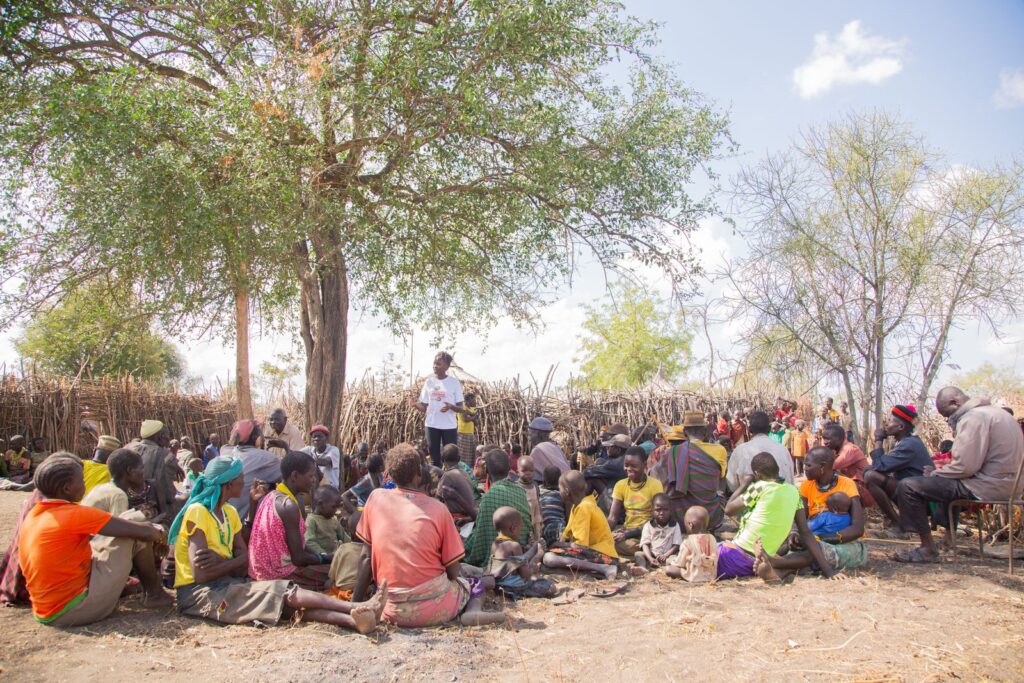
Under a big tree in a village outside Nsukka, about forty people sit on benches and plastic chairs. Women hold babies. Old men lean on walking sticks. A young man from a local NGO stands in front of them with a flipchart. He is asking them what they need.
That meeting is where a strong community development grant proposal begins. Not in an office. Not on a laptop at midnight before the deadline. Under the tree.
Many African organisations lose community development funding because their proposals read like the NGO decided everything alone and then went looking for money. Funders can smell this. In this guide, I will show you how to write a proposal that proves the community is at the centre, and that your organisation can deliver.
What Funders Look For in Community Development Projects
Community development is broad. It can mean water and sanitation, livelihoods, youth skills, maternal health, roads, or local governance. But the funders who support this work tend to ask the same core questions:
- Did the community identify this need, or did you?
- Is there evidence the problem is real and serious?
- Will the community own the project after the grant ends?
- Can your organisation manage the money and report honestly?
- What will be different, and how will you know?
Every section of your proposal should answer at least one of these. If a paragraph answers none of them, cut it.
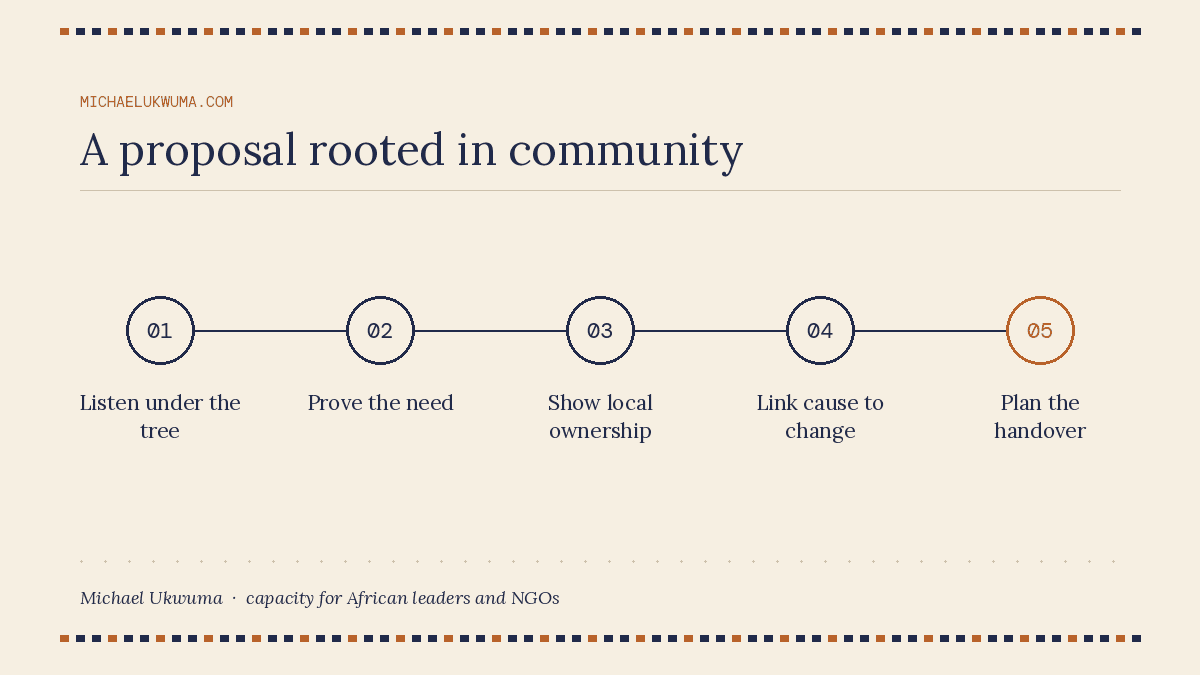
Step 1: Start With the Community, Not the Budget
Before you write a word, go back to the people. Hold a consultation. Talk to women separately from men if culture makes it hard for women to speak openly in mixed meetings. Talk to youth. Talk to traditional rulers and the town union.
Document everything. Take attendance. Take photos with consent. Write minutes. These records become evidence in your proposal. A sentence like “We held three consultations with 112 residents in March, including 61 women” is worth more than a page of adjectives.
Step 2: Write a Needs Statement Built on Evidence
Your needs statement must combine two kinds of proof. First, local data from your own consultations and baseline surveys. Second, external data from sources like national statistics bureaus, health surveys, or reports from credible agencies.
Show the gap. Describe the problem, show who is affected, and explain what happens if nothing changes. Keep it specific to your community. Funders do not need another paragraph about poverty in sub Saharan Africa. They need to know about this village, this ward, this local government area.
I wrote a full guide on how to write a needs statement for a grant proposal if you want to go deeper on this section.
Step 3: Show Community Ownership in the Design
This is where most community development grant proposals are weak. Say clearly what the community will contribute. It could be land, labour, a management committee, or a small cash contribution. Even a modest contribution signals commitment.
Describe the structure that will hold the project together. Is there a water committee? A cooperative? A youth group with elected officers? Name it. Explain how members are chosen and how decisions are made. Funders want to see that a real local structure will carry the work when your staff step back.
Step 4: Build a Clear Theory of Change
Link your activities to outcomes in a logical chain. If you train fifty women in poultry farming, what happens next? They start businesses. Household income rises. Children stay in school longer. Each step needs a reason and, where possible, evidence that it works.
I recently wrote about theory of change for NGOs and how to write one that holds up under a funder’s questions. If your funder asks for a logframe instead, see how to write a logframe. The short version: be honest about assumptions. Funders respect an organisation that names its risks.
Step 5: Make Your Budget Tell the Same Story
Your budget should mirror your narrative. If your proposal talks about community training, there must be training costs. If you promise monitoring, budget for transport to the field. Show the community contribution as a line, even when it is in kind.
Avoid inflated figures. Experienced programme officers know what a borehole or a training day roughly costs in your region. A padded budget destroys trust faster than any typo.
Step 6: Plan for Sustainability From Day One
The question every funder asks silently is this: what happens when our money runs out? Answer it directly. Will user fees maintain the facility? Will local government take over staff costs? Will the cooperative generate enough income to continue?
Be realistic. Do not promise that a community will fully fund a clinic in eighteen months. Show a gradual handover with clear milestones.
Step 7: Monitoring, Evaluation and Learning
Explain how you will measure change. Name a few indicators, set baseline values, and give targets. Say who collects data, how often, and how the community will see the results. Feeding results back to the people under the tree is not a luxury. It is part of accountability.
Common Mistakes in a Community Development Grant Proposal
- Writing as if the NGO is the hero and the community is passive.
- Copying a generic proposal from another region without adapting it.
- Ignoring local government and traditional structures.
- Promising outcomes the budget cannot possibly deliver.
- Submitting without a single quote, photo, or data point from the actual community.
For a wider list, read why grant proposals get rejected and how to fix yours. And if you are still looking for the right funder, my list of grants for community development in Africa is a good place to start.
Return to the Tree
When the funder reads your proposal, they should be able to picture the meeting under the tree. They should hear the voices of the women with babies and the old men with walking sticks. They should believe that the money will strengthen what the community already started.
That is the proposal that gets funded.
If you need help shaping a community development grant proposal, from consultation design to the final budget, I work with NGOs across Africa on exactly this. Explore my grant writing and consulting services or reach out directly to talk through your next application.