
The report sits on a shelf in the executive director’s office. It is bound in a blue cover. Inside are forty pages of findings from last year’s organisational capacity assessment. Governance scored low. Financial systems scored medium. Monitoring and evaluation scored low. There are charts. There are recommendations.
Nobody has opened it since the consultant left.
I have seen that blue report in more offices than I can count. The assessment was done. The money was spent. But nothing changed, because nobody turned the findings into a capacity building plan for the NGO. This post shows you how to do exactly that.
Why Assessments Fail Without a Plan
An assessment tells you where you are. A plan tells you where you are going, who is driving, and how much fuel you need. Without the second, the first is just an expensive mirror.
Most organisations stall for three reasons. The findings feel overwhelming, so nobody knows where to start. Nobody is assigned to own the follow up. And there is no budget attached, so every improvement competes with programme work and loses.
A good capacity building plan for NGOs solves all three. If you have not yet done the assessment itself, start with my guide on organisational capacity assessment for NGOs, then come back here.
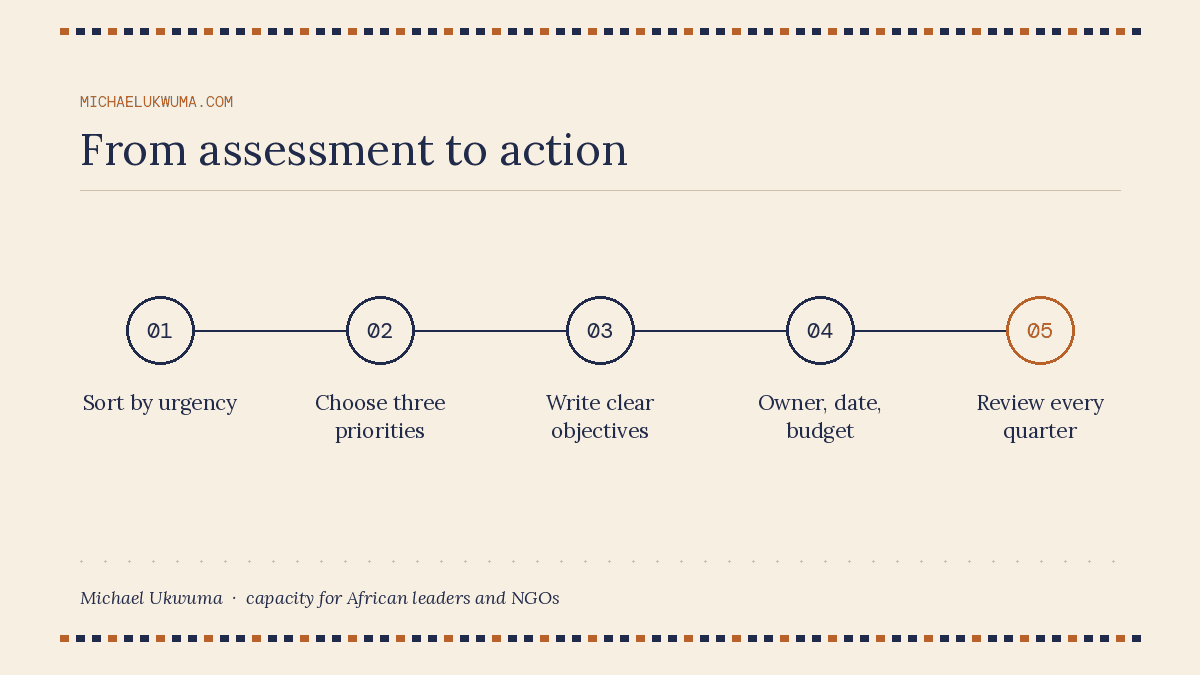
Step 1 of a Capacity Building Plan for NGOs: Sort Findings by Urgency and Impact
Take every gap from the assessment and put it on a simple grid. One axis is urgency: does this threaten funding, compliance or safety right now? The other is impact: if we fix this, how much stronger does the whole organisation become?
Gaps that are both urgent and high impact go first. These are often things like a missing audit, weak financial controls, or no safeguarding policy. A funder can walk away over any of them.
Gaps that are high impact but less urgent come next. Strategy, board development and staff skills often sit here.
Low impact items can wait. Be disciplined. You cannot fix everything in one year.
Step 2: Choose Three to Five Priorities for the Year
This is where courage is needed. Pick no more than five priorities for the next twelve months. Small organisations should pick three.
I know the temptation. The assessment found twelve problems and you want to solve all of them. But a plan with twelve priorities has none. Staff are already stretched. Focus is how small NGOs win.
Step 3: Write a Clear Objective for Each Priority
For each priority, write one objective that describes what success looks like. Make it specific and measurable.
Weak: “Improve financial management.”
Strong: “By June 2027, the organisation has an approved finance manual, monthly reconciliations completed within ten days, and a clean external audit.”
The strong version tells everyone exactly what done looks like.
Step 4: Break Each Objective Into Actions
Under each objective, list the actions needed. Keep them concrete. For the finance example, actions might include drafting the finance manual, training the finance officer and programme managers, setting up a monthly reconciliation routine, and appointing an external auditor.
For each action, record four things:
- Owner. One person, by name or role. Not “management”. Not “the team”.
- Deadline. A real date.
- Resources. Money, time, external support or tools needed.
- Evidence. How will you prove it was done? A signed policy, a training attendance list, an audit letter.
This is the backbone of the capacity building plan. Put it in a simple table. A spreadsheet is fine.
Step 5: Match Each Gap to the Right Kind of Support
Not every gap needs training. This is one of the most common mistakes in African NGO capacity building. Every problem gets a workshop. The workshop ends, people go home, and nothing changes.
Match the support to the gap:
- Knowledge gaps respond to training and short courses.
- Skill gaps need practice, coaching and mentoring over time.
- System gaps need new policies, tools and processes.
- Structural gaps need decisions about roles, governance or staffing.
- Culture gaps need leadership modelling and patience.
If your M&E is weak because nobody owns it, a training course will not fix it. A decision to assign the role will. My NGO capacity building framework goes deeper into these categories.
Step 6: Put a Budget on It
A capacity building plan without a budget is a wish list. Cost each action, even roughly. Then look for where the money will come from.
Many institutional funders allow organisational strengthening costs within project budgets if you ask. Some offer dedicated capacity grants. Unrestricted income from individual donors can also cover core improvements. Show the plan to your funders. A clear, costed plan makes you far more fundable than a vague request for “capacity support”.
Step 7: Review Every Quarter
Set a quarterly review meeting with senior staff and, ideally, a board member. Go through every action. What is done? What is late? Why? What needs to change?
Keep the review short and honest. The goal is not to punish people for delays. It is to keep the plan alive so it never becomes another blue report on a shelf.
At the end of the year, repeat a light version of the assessment. Compare scores. Celebrate progress. Then set the next year’s priorities.
A Note on Leadership
Capacity building is not a project the executive director delegates and forgets. Staff watch what leaders pay attention to. If you ask about the plan in every management meeting, they will take it seriously. If you never mention it, neither will they.
This is also where many founders struggle. Building systems means letting go of control. If that sounds familiar, my post on delegation for nonprofit leaders may help. And once the plan is running, my guide to an NGO sustainability plan shows how to keep the gains after a grant ends.
Get Support to Build Your Plan
Turning an assessment into a working capacity building plan is one of the most valuable pieces of work an NGO can do, and one of the easiest to postpone. I facilitate this process with NGOs across Africa, from prioritisation workshops to costed plans your funders will respect.
Learn more about my capacity development services or get in touch to talk about where your organisation is today and where you want it to be by this time next year.